

Altamond Enterprise: ‘The battle is yet to be engaged’: Underground Railroad Center lawsuit is moving forward
Melissa Hale-Spencer for The Altamont Enterprise, August 7, 2026
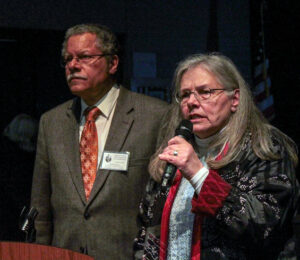
ALBANY COUNTY— After months of delay, Mary Liz and Paul Stewart are relieved their case is going forward.
On March 20, Lawyers for Good Government had filed a federal suit on behalf of the Underground Railroad History Project, which was founded by the Stewarts in 2003.
The project is now housed in the restored brick rowhouse on Livingston Avenue where Black abolitionists Harriet and Stephen Myers once lived. But the Stewarts had plans to build an interpretive center nearby.
Those plans were derailed when the Trump administration made cuts to already-awarded grants.
The suit, filed by Nina Loewenstein, describes the Myers House as “a community anchor in a majority Black, economically disinvested neighborhood” and says the Stewarts’ project “interprets the Underground Railroad movement as a civil rights movement propelled toward social and racial justice … and the people at its center are a source of pride and lessons for contemporary struggles for equality and opportunity.”
The trigger for the suit was the abrupt and unexplained withdrawal of a $250,000 Challenge Grant from the National Endowment for the Humanities, which was to help support the building of the interpretive center.
Loewenstein emailed the Stewarts on Aug. 6 that the night before that the government defendants had filed an answer to the complaint.
“They did not move to dismiss it, as we had been anticipating,” Loewenstein wrote. “This is really good, we will be moving along now with the case.”
The government had been granted two previous extensions.
“I’m glad it’s going forward,” Paul Stewart told The Enterprise on Aug. 7. “But the battle is yet to be engaged.”
Asked earlier if the Underground Railroad Education Center would accept a settlement rather than going to trial, Stewart said, “I think we would be happy with a settlement if we got the funds back.” He added, “A lot depends on the details.”
The trigger for the suit was the abrupt and unexplained withdrawal of a $250,000 Challenge Grant from the National Endowment for the Humanities, which was to help support the building of the interpretive center.
The suit, filed against the NEH, the Department of Government Efficiency, and the Office of Management and Budget along with two officials, seeks an order declaring the withdrawal of the Stewarts’ grant as unconstitutional, and setting aside the Trump directive that caused the withdrawal.
The suit argues that the grant withdrawal violates both the First and Fifth Amendments of the Constitution.
It also argues that the Congressional intent in founding NEH “was to ensure that what is now sometimes short-handed as ‘DEI’ and branded by Defendants as illegal and undesirable, would be central to NEH’s mission … This mandate was carried out for 60 years, under Democratic and Republican administrators until upended this past Inauguration Day.”
The suit goes over the rigorous review process that each NEH grant applicant, including the Stewarts, underwent to be selected, concluding that only 16 percent receive funding, representing “the best of the best.”
The Underground Railroad center accepted its NEH award in February 2024 and, as required, submitted full environmental assessment and financial review documents by May of that year. Ahead of schedule, in July, the Stewarts certified matching gifts for the first year.
That December, NEH confirmed that “NEH absolutely sees the value of this project and the benefit that it will bring the community.”
NEH communicated nothing further until, on May 14, 2025, it sent an email saying that the offer was being withdrawn and that the decision could not be appealed.
“NEH is repurposing its funding allocations in furtherance of the President’s priorities,” the withdrawal notice said.
The Stewarts’ grant was among 1,477 identified for termination, including dozens related to United States Black history and communities.
The Stewarts say they would have likely had enough to build the interpretive center, estimated to cost between $12 million to $15 million, if the Trump administration hadn’t pulled back promised federal funds.
Two different federal grants — from the Environmental Protection Agency and from the National Endowment for the Humanities — that together totaled just under $4 million were withdrawn.
Mary Liz Stewart told The Enterprise earlier that two additional grants, each for $2 million, depended on having enough money committed. So, with the federal grants withdrawn, the Underground Railroad Education Center lost about $8 million, she said.
“The two pools of $2 million each would have been the last money in the door,” said Mary Liz Stewart.
In June, the Underground Railroad Education Center received a $2,080,000 grant from the New York Council on the Arts to go towards building the Arbor Hill interpretive center. With those funds, the center now has about $7 million, instead of having enough funds to start construction.
“We certainly feel like we’ve made, through our lawyers, a very strong case for them having basically violated their own rules,” Paul Stewart said on Friday of the National Endowment for the Humanities.
“And so we think that’s a good argument for us to be reinstated. And I hope we are reinstated, because every little bit of the funds that we’ve been trying to raise for putting the interpretive center in place, all of those funds are important for the overall project.”
He also said, “We are talking about doing a capital campaign, which we hope will be able to help us pick up $4 to $5 million … and it does look like right now we’re competitive for some of that downtown revitalization money.”
Stewart regrets that his organization had no legal recourse to recoup promised funds from the federal EPA.
“We’d really love to be able to go back to the Environmental Protection Agency and say, ‘Hey, you also violate your own rules.’ But we were not the lead applicant,” he said.
The lead applicant was Trinity Alliance of the Capital Region, which was established as a settlement house in 1912 and now provides programs and services to inner-city neighborhoods in Albany and Troy.
“They actually did attempt to do a class-action suit,” Stewart said of Trinity Alliance, but the judge ruled it should go to the Court of Claims. “In the Court of Claims, you can only recover what you have actually physically dollar-wise lost,” said Stewart. “So that was a big disappointment.”
Mary Liz Stewart told The Enterprise earlier that the center had planned on hiring a number of small contractors for the project who were minority and women business enterprises, known as MWBE, which means they are owned by a woman or by someone from a minority group.
One of the companies the Stewarts worked with was the New World Barn Company based in Altamont, which salvaged timbers of a 1700s barn — from a farm where slaves had worked — to be used to build an entry to the modern center.
“We had a whole slew of subcontractors who were lined up, ready to go …,” she said. “So, while we, organizationally, have been impacted, so have these small businesses that now are just either sitting around waiting or they are obviously looking for other jobs as well. But there was a lot of excitement about these, particularly some of the smaller businesses.”
“In the event that we’re able to get the money that we need to move forward,” Paul Stewart said on Friday, “we’re going to have to go through some of these steps all over again and re-recruit people and whatnot.”